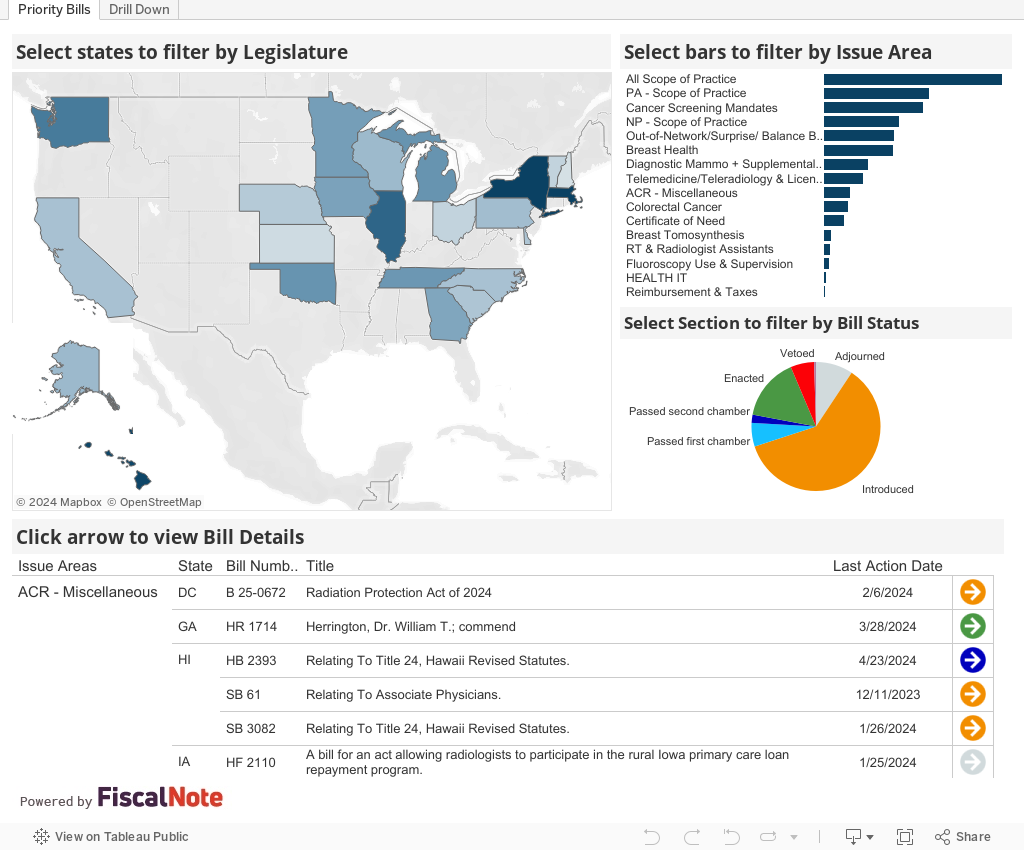
External fund requests will only be awarded for scope of practice state advocacy efforts that are aligned with ACR core purpose or a national ACR priority objective. The College will only consider external requests that come from state chapters, not single members.
Chapters applying for ACRA funds must demonstrate a significant chapter and member commitment to the scope of practice public policy effort. This commitment may include at least a 50% match of chapter funds to the grant amount being sought from ACRA, OR the chapter may provide a substantial amount of in-kind services to support the project. The estimated value of these in-kind services (which may include staff and volunteer time specifically dedicated to the project, as well as other project-related materials and services) should reasonably correspond with the amount of unmatched funds requested from ACRA.
Individual earmarks for individual chapter requests may not exceed one-fifth of the total amount budgeted for this program in a legislative cycle. A limit of $10,000 per fiscal year is recommended. Funds may be awarded to the same chapter for the same initiative in subsequent years, but only if the chapter can demonstrate that commensurate progress was made on the initiative as a result of the previous fund investment and that there is a reasonable chance that a subsequent funding contribution could result in the successful completion and fulfillment of the original goals of the initiative.
Chapters must demonstrate that funds from ACRA would have no taxable impact on ACRA and would comply with all applicable legal requirements.
Funds cannot be used to fund chapter PACs.
Types of Requests Anticipated
Requests for expenditures of funds/resources from the Scope of Practice Fund may fall into the following categories:
- Joining scope of practice coalition projects already underway at the state level and/or initiated by the state medical societies
- Hiring a contract lobbyist/strategist to represent radiology interests on the scope of practice matters with direct lobbying
- Partial contributions towards a group retainer scope of practice lobbyist (with other specialties or state AMA)
- Partnering with other stakeholders in engaging a public relations firm on media outreach related to scope (scope of practice campaign web presence and social media recurring communications)
- Grassroots/Grass tops campaigns
- Partnering in engaging services of a political strategist (polling on messaging/focus groups)
- Advertising content (radio/internet/targeting email or social medial placement)
- Constituent outreach (email/phone banks) targeting voting constituents in critical districts
- Legal fees related to scope (i.e. joining lawsuits, amicus briefs development, analysis etc.)
Chapters seeking funds must submit a request in writing outlining the project and detailing how the request meets all the criteria established in this program. Chapters are encouraged to use the State Scope of Practice Fund application form in preparing their submission.
Funding requests must include:
- A detailed breakdown of how funds would be spent
- A description of the public policy effort, including strategies, tactics, allies, adversaries and the political climate as it applies to the possible success of the effort
- Information on other organizations (if any) involved in the advocacy effort and the level of commitment provided by those organizations
Scope of Practice Fund requests will be reviewed by the State Government Relations Committee which will provide a recommendation to the Executive Committee of the ACRA BOC. The committee will develop its recommendation based on the criteria established for this program and the availability of funds budgeted for the program. The Executive Committee of the ACRA BOC will make the final decision on all state fund requests.
All fund requests should be submitted to ACRA State Affairs staff.
Successful Scope of Practice Fund awardees are expected to provide the State Government Relations Committee with updates on the progress of their project at quarterly intervals or upon request from ACRA.
ACRA requires an invoice and will disburse direct payment to the vendor for services or project expenses on a rolling basis. For example, for services of a PR firm or for placement of a print ad, the billed amount must be invoiced to the ACRA vs. issuing a lump sum payment to any state society for the fiscal year to avoid instances where unspent funds must be sheltered and/or returned to the ACRA.
At the completion of the project, awardees should provide a brief written summary of their project detailing results and any lessons learned, supply a copy of all work product related to the project (i.e. testimony, draft language, etc.). The ACRA may utilize summaries for advocacy training and/or digital and print promotional materials. The awardees may also be invited to present their summaries to the State Government Relations Committee at its quarterly call meetings or at the in-person meeting during the Annual Meeting.